
If you work with sustainability at an SBTi-validated company, carbon removal has probably just moved from "someday" to "on my desk". The reason has a date: 1 February 2027, when SBTi's Net-Zero Standard V2.0 goes live. That date is no longer far away, and the closer it gets, the less abstract CO₂ removal becomes as part of the overall sustainability strategy. It is turning into a concrete planning task.
What SBTi's Net-Zero Standard V2.0 means for Category A companies
From 1 February 2027, companies can validate their targets under SBTi's new Net-Zero Standard V2.0, and from 2028 it applies to all new submissions. (Source: SBTi, Corporate Net-Zero Standard V2.0, June 2026) Companies in what SBTi calls Category A, meaning large companies everywhere plus medium-sized companies in high-income countries, will have to publish a transition plan within 15 months of their targets being validated. That makes this the moment to make sure the board, management and other stakeholders understand what CDR means for future planning, and that they can answer questions like these:
- Does our long-term strategy include a budget line for CDR purchases from 2035 onwards?
- Do we have a procurement process for carbon removals, and when do we need to start contracting to secure supply?
- What capacity and competence does our sustainability team need to manage this?
- What criteria will we apply when buying CDR: durability, geography, co-benefits or price?
- Which developers and projects do we want to back early, before supply is spoken for?
- Which types of removal will still count when we reach net zero, and which ones will not?
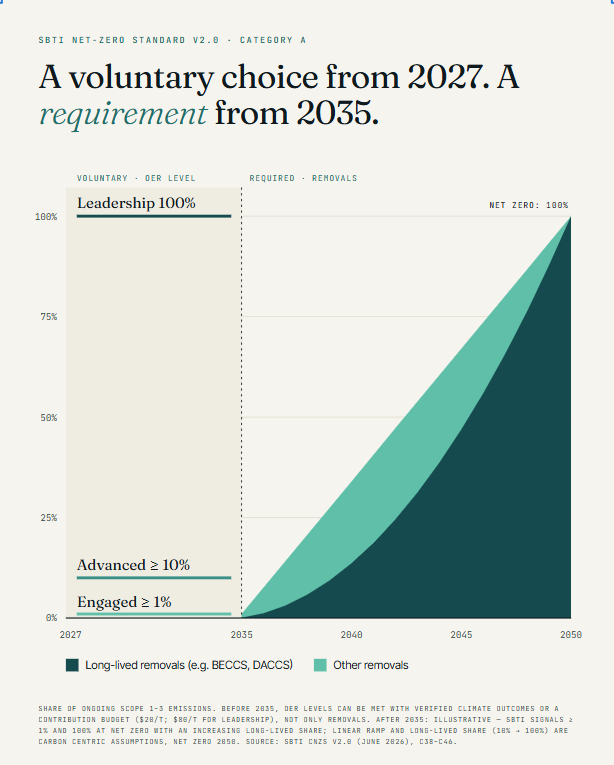
The number of SBTi-validated companies is growing every year, from just over 1,000 in 2021 to more than 10,000 today, with 2,800 new companies added in 2025 alone. (Source: SBTi, April 2026) That shows how many will face the same challenge between now and 2035, when Category A companies are set to start procuring carbon removals equivalent to at least 1% of their ongoing emissions. That share is then set to rise every year until it reaches 100% at net zero. The figure below shows the shape of it: three voluntary OER levels from 2027, then a required ramp from 2035, where the share that must come from long-lived removals such as BECCS and DACCS grows from 10% to 100% by the net-zero year. If every Category A company starts looking for a CDR supplier at the same time, there won't be enough to go around: so far, the entire durable CDR market has delivered around 1.7 million tonnes. (Source: CDR.fyi, October 2026)
Durable removal cannot be scaled up at short notice. A BECCS or DACCS plant takes years to plan, finance and build, and every tonne must be measured, verified and certified by independent third parties before it can be sold. New capacity only gets financed once there is firm demand behind it. In practice, that means the durable removal available in 2035 is being decided by the contracts signed over the next few years. And durable is what will be needed: as Category A companies approach net zero, durable CDR will be the only kind that counts for long-lived emissions like CO₂. That like-for-like principle is required at net zero under V2.0, and we hope it stands firm in V3.
Some buyers are not waiting for 2035. KLP, DNV and Zephyr have all signed agreements with Carbon Centric for permanent removals from our BECCS plants, securing supply years before it becomes a requirement. Public buyers are moving too: the City of Stockholm has signed for 750,000 tonnes of BECCS removals over 15 years (Source: City of Stockholm, May 2026), and the City of Zurich is among our own customers through Climeworks. None of them are bound by an SBTi deadline.




Our buyers
The question is no longer whether CDR should become part of your sustainability strategy. It's whether you start planning in time. 2035 is closer than it looks, and 2027 and 2028 will tell the tale. From February 2027, every Category A company validating under V2.0 must declare whether it will take part in Ongoing Emissions Responsibility (OER) at Engaged, Advanced or Leadership level (the left-hand side of the figure), or opt out and explain why in writing to SBTi. The answer is published on the SBTi dashboard. For the first time we will get real data on how many SBTi-validated companies choose to take responsibility for their ongoing emissions while they are still voluntary, before it becomes mandatory for Category A in 2035. Adding CO₂ removal and CDR certificates to the company's long-term sustainability strategy isn't done overnight.
Carbon Centric works with Category A companies on exactly this, from budget and procurement to choosing the right type of removal. Book a meeting with our team and start the planning now.