Carbon Centric captures CO₂ from the flue gas of plants that burn waste and biomass. Today, at Rakkestad, the captured CO₂ goes to industrial use. The next plant, Kirkenær, will instead send the CO₂ to permanent storage deep underground. Because the biomass absorbed CO₂ from the air while it grew, the result is that the atmosphere holds less CO₂ than before. That is called carbon removal, or BECCS.
What we sell are CDR certificates: one certificate is one tonne of CO₂ removed and stored permanently, checked by an independent third party. Today they are sold as pre-purchases, delivered once Kirkenær is operating.
Is it possible to capture CO₂ from waste and biomass at this scale?
Yes. Rakkestad CCU is in operation and captures CO₂ from the flue gas at Østfold Energi's waste incineration plant. The technology is an amine-based absorption process that has been in industrial use for decades, including in gas processing. This is not a pilot plant but a full-scale commercial facility with a capacity of 10,000 tonnes per year. You can come and see it.
What is BECCS, and how does it differ from other carbon capture?
Carbon capture and storage (CCS) means capturing CO₂ from a chimney and storing it permanently in bedrock instead of releasing it. Applied to a fossil source, such as a cement plant, it reduces emissions. That matters, but it does not remove CO₂ already in the atmosphere. BECCS (Bio-Energy with Carbon Capture and Storage) is CCS applied to a biogenic source: wood and other organic material that absorbed CO₂ from the air while it grew. When that CO₂ is captured and stored permanently, the balance goes negative. The atmosphere holds less CO₂ than before. This is what is called carbon dioxide removal (CDR), and it is what Carbon Centric is building the Kirkenær and Skogn plants to deliver.
Isn't this just greenwashing?
We understand the scepticism. The carbon market is full of projects that have delivered little or nothing, and of companies that have called themselves "climate neutral" on thin evidence. We do two things to avoid being one of them. First, we only sell removal that is measured with calibrated sensors, reported in our MRV platform and approved by an independent auditor under a recognised methodology. No one can buy a certificate from us that has not been verified. Second, we say plainly what is captured today (Rakkestad, for industrial use) and what is a pre-purchase of future removal (Kirkenær).
Doesn't carbon capture just prolong the age of oil?
It is a fair question, because carbon capture is often mentioned in the same breath as oil and gas. But in practice, carbon capture is used in two quite different places. One is BECCS, capturing biogenic CO₂ from wood and waste, which delivers carbon removal. The other is industry that cannot cut its emissions any other way, known as 'hard to abate': cement production, where most of the CO₂ comes from the limestone itself rather than from energy use, and waste incineration, where residual waste has to be burned regardless and the plastic in it produces fossil CO₂. Heidelberg Materials' cement plant in Brevik and Hafslund Celsio's waste-to-energy plant at Klemetsrud in Oslo are both examples. Carbon Centric works exclusively with bioenergy and waste facilities.
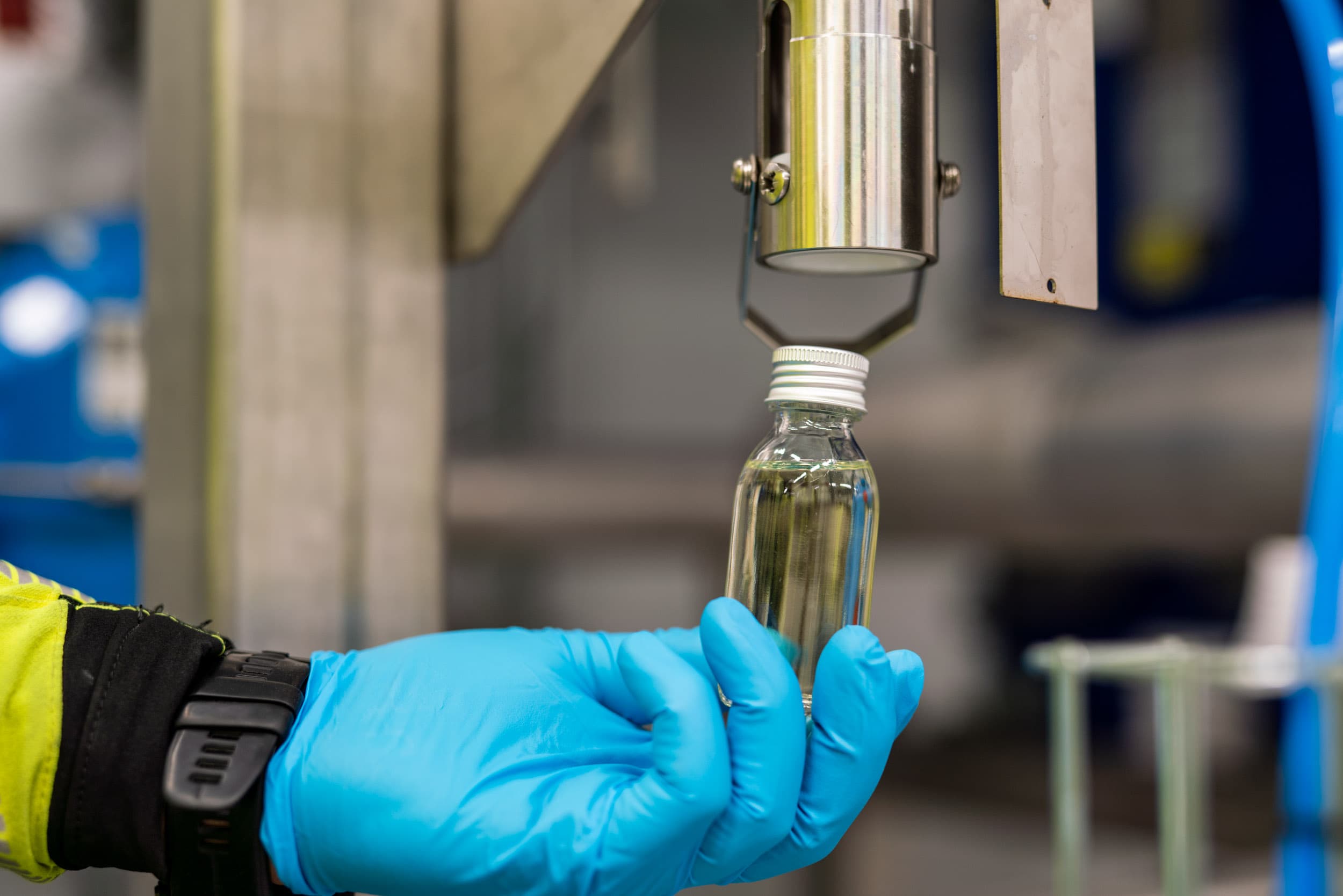
Solvent sampling at the Rakkestad plant. The analysis forms part of the ongoing verification process.
What is the difference between a CDR certificate, a carbon credit and an emissions allowance?
The words are used interchangeably, so here is the distinction we stick to. An emissions allowance (for example in the EU Emissions Trading System, EU ETS) is a permit to emit one tonne of CO₂. It removes nothing. A carbon credit is a voluntary certificate that one tonne of CO₂ has been avoided or removed somewhere, and quality varies enormously, from forestry projects with uncertain effect to permanent geological storage. A CDR certificate is the strictest kind of carbon credit: one tonne of CO₂ physically removed from the atmosphere and stored permanently, verified by an independent third party. This is what Carbon Centric sells, from projects built for exactly that, such as Kirkenær and Skogn. When we say "credit" on these pages, we always mean a CDR certificate.
What is MRV, and who verifies it?
MRV stands for measurement, reporting and verification. At Rakkestad, over 450 sensors continuously log CO₂ concentration, temperature, pressure and flow rate, and the data is reported automatically to our MRV platform. For carbon removal from Kirkenær, an independent third party, accredited under a recognised carbon removal methodology, will review and approve the data before certificates are issued. The methodology also requires documentation of the whole chain, from where the biomass comes from to confirmation that the CO₂ has actually been injected into storage. We cannot issue certificates we do not have documentation for.
You sell certificates for CO₂ that has not yet been captured. Is that honest?
Yes, as long as it is stated clearly, and it is standard practice in the global CDR market. What we sell today are pre-purchases of future certificates from Kirkenær and Skogn. The buyer secures volume and helps finance the construction of the facilities; without such agreements the plants do not get built. Certificates are delivered only after the CO₂ has been captured, stored, documented through MRV and verified by a third party. Until then, it is a contractual commitment with a delivery deadline, not a claim that anything has already been removed. If we fail to deliver, the buyer gets their money back. Nearly all leading CDR projects in the world are financed the same way; see for example cdr.fyi for an overview of the market.
Is biomass truly carbon-neutral?
It is a legitimate debate, and the answer is no, not automatically. It depends on what is burned and where it comes from. The plants we build on burn residual waste and biomass that cannot be used for anything else: residual waste that would have to be incinerated regardless (Rakkestad), and wood chips and residues from forestry and industry (Kirkenær, Skogn). We do not build capture on plants that burn virgin forest. Residual waste also contains plastic, which produces fossil CO₂ when burned. We capture that CO₂ too, but only the biogenic share can count as carbon removal. The fossil share is a reduced emission, and we keep the two strictly apart in the accounting. It is not perfect, but it is measurably better than emitting all of it.
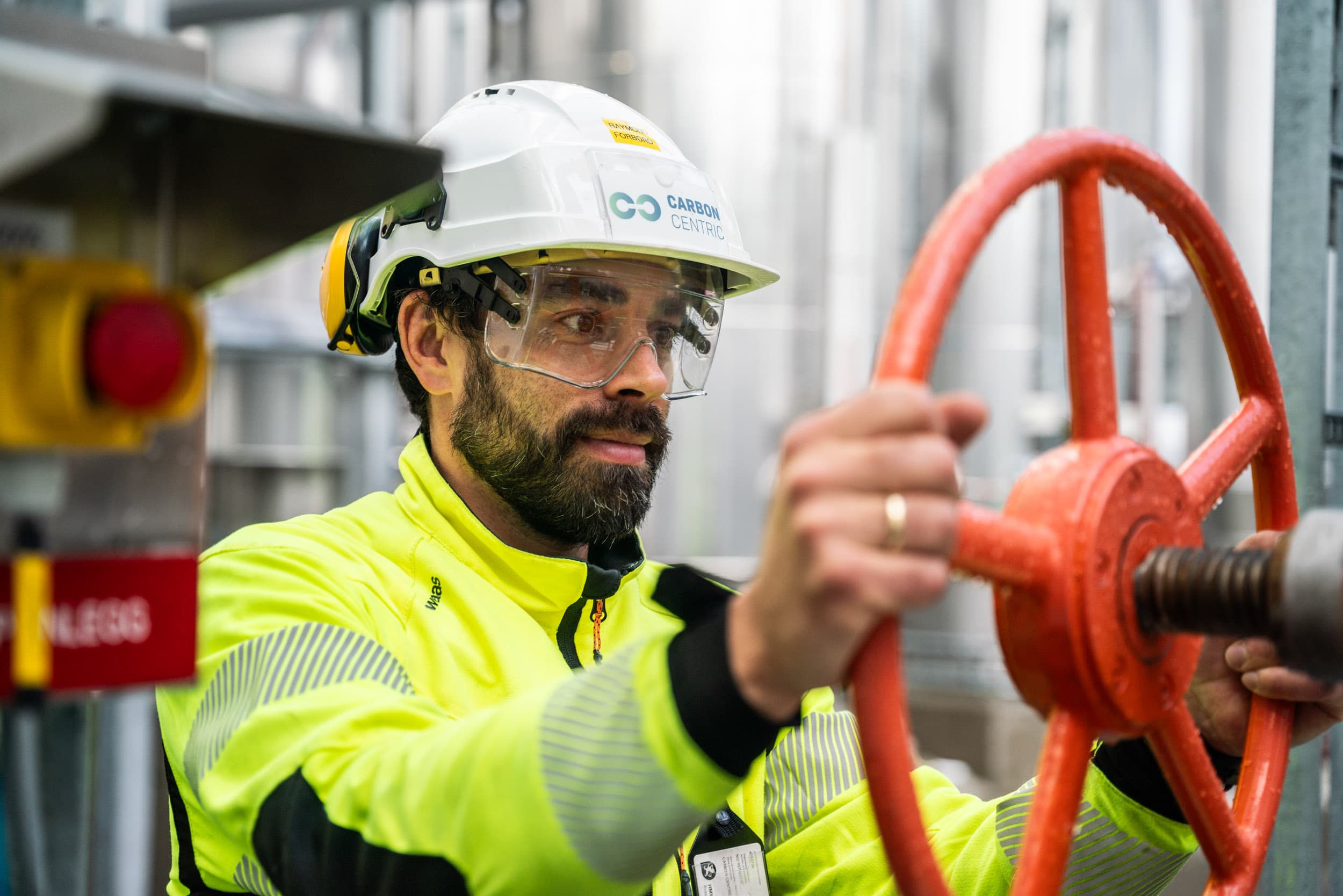
Raymond Forbord adjusting a valve at Rakkestad CCU. The plant is monitored and maintained by Carbon Centric's own operations team.
What happens to the CO₂ after it is stored? Can it leak out?
This is not new in Norway. Equinor has stored CO₂ in the Utsira formation beneath the North Sea at the Sleipner field since 1996, and at Snøhvit since 2008, and has monitored the stores with seismic surveys throughout. Northern Lights, the storage part of the Longship project, received its first CO₂ in August 2025 and injects it into sandstone 2,600 metres below the seabed. The way it works is the same mechanism that has kept oil and gas in place for millions of years: the CO₂ is pumped down as a dense fluid into porous sandstone, beneath a thick layer of impermeable shale it cannot pass through. Over time it is trapped in the pores by capillary forces, dissolves into the formation brine and becomes heavier than the surrounding water, and some of it reacts with minerals and turns to rock. Each step makes the storage more secure, not less. The store is monitored with seismic surveys and pressure measurements in the wells, and the operator remains responsible for it for decades after injection ends. In Iceland, where our Kalka project is located, it happens faster: in basalt, CO₂ binds to rock within two to four years, as documented by CarbFix.
What is the status right now? Is this actually happening?
Yes, and 2025 was the year it went from plans to operations in Norway. Northern Lights, the storage part of the state-backed Longship project, received and stored its first CO₂ in August 2025 and is now expanding capacity to at least five million tonnes per year. Heidelberg Materials opened the world's first full-scale carbon capture plant at a cement factory in Brevik in June 2025, with a capacity of around 400,000 tonnes per year, and the CO₂ is shipped to Northern Lights. Hafslund Celsio began construction of the capture plant at the Klemetsrud waste-to-energy facility in Oslo in autumn 2025, with start-up planned for 2029. In 2026, Inherit Carbon Solutions delivered the world's first verified carbon removal certificates from biogas, with storage at Northern Lights. In Sweden, Stockholm Exergi is building an 800,000-tonne-per-year BECCS plant due to start in 2028, and in Denmark Ørsted is building capture at two biomass power plants for storage in Norway. In the Netherlands, the Porthos storage site off Rotterdam is under construction, with first injection now expected in 2027. Globally, the Global CCS Institute counted 77 facilities in operation in autumn 2025. And on the regulatory side, the EU's first certification methodologies for permanent carbon removal, including bio-CCS, entered into force in May 2026. Carbon Centric's own contribution is Rakkestad, in operation since September 2025, and Kirkenær under development with start-up planned for 2028. This list was updated in September 2026.
How does the counter on the homepage work?
The figure is built on real data from our database on what is captured at the Rakkestad plant. The total itself updates whenever new figures are reported, typically a few times a day. In between, the counter moves forward steadily based on the average capture rate, so what you see is a realistic projection of what is being captured right now, not a random number. Note that this is CO₂ captured for industrial use (CCU), not carbon removal. It is always the actual reported figure that underlies everything we document.
Talk directly with our team
Do you have questions we have not answered here, or would you like to see the Rakkestad plant with your own eyes? We are available.
Get in touchExternal status and figures on this page are taken from the organisations' own publications and were updated in September 2026. If you find something outdated or wrong, please tell us.
The terms, explained without the jargon
Carbon capture, CCU, CCS, BECCS, CDR, emissions allowances and carbon credits are often used as if they meant the same thing. They do not, and the difference is the whole point. Here are the words as we use them, in alphabetical order.
The requirement that the carbon removal would not have happened unless someone paid for it. A capture plant at a bioenergy facility does not get built on its own; it is financed by buyers of certificates. That is why pre-purchases matter so much.
Article 6 of the Paris Agreement lets countries cooperate on climate targets, for example by one country paying for emission cuts or removals in another and having them credited. The unit transferred is called an ITMO (Internationally Transferred Mitigation Outcome). Norway and Switzerland have a pilot agreement on this, and Carbon Centric supplies carbon removal from Kirkenær into it, via Climeworks.
Bio-Energy with Carbon Capture and Storage: carbon capture and permanent storage at a plant that burns biomass. Because the biomass absorbed CO₂ from the air while growing, the net result is CO₂ removed from the atmosphere. Kirkenær and Skogn are BECCS projects. EU regulation uses the term BioCCS.
Biomass Carbon Removal and Storage. A broader umbrella term than BECCS, covering all carbon removal where biomass is the feedstock, regardless of whether energy is produced. Capturing CO₂ from biogas production or from a paper mill is BiCRS, but not necessarily BECCS in the strict sense.
Biogenic CO₂ comes from material that was recently alive: wood, food waste, paper. This CO₂ was in the atmosphere a short time ago, and if it is captured and stored, it has been removed. Fossil CO₂ comes from oil, gas and coal, and from plastics made from them. If it is captured, the emission is reduced, but nothing has been removed. Residual waste contains both, and a serious accounting keeps them apart.
Charred biomass mixed into soil or building materials, where the carbon remains for hundreds of years. A different form of carbon removal from BECCS, with shorter durability than geological storage but easier to do at small scale. Biochar is one of the first three methods the EU has approved under the CRCF.
Carbon Centric's business model: we build, own and operate the capture plant ourselves, while the owner of the energy plant continues to own and operate the boiler and supplies the flue gas to us. The industrial partner needs neither capital nor capture expertise to get started.
Separating CO₂ from flue gas before it leaves the chimney. In our plants this is done with an amine-based liquid that binds CO₂ in one column and releases it again when heated in another. Carbon capture says nothing about what happens to the CO₂ afterwards; storage or use is what determines the climate effect.
Carbon Capture and Storage: capturing CO₂ and storing it permanently in bedrock, in practice in sandstone formations deep beneath the seabed. CCS on a fossil source reduces emissions. CCS on a biogenic source (BECCS) delivers carbon removal. Longship, with Northern Lights as the storage site, is Norway's state-backed CCS programme.
Carbon Capture and Utilisation: captured CO₂ is used as a raw material, for example in greenhouses, in the food industry or to make synthetic fuels. The CO₂ then replaces CO₂ that would otherwise have to be produced from fossil sources, but it is eventually released again. CCU is therefore not carbon removal. Rakkestad is a CCU plant.
Carbon Dioxide Removal: taking CO₂ out of the atmosphere and storing it so it does not come back. Tree planting is short-duration CDR; BECCS, DACCS and biochar are long-duration CDR. The UN climate panel writes that CDR is unavoidable for reaching net zero, because some emissions cannot be cut.
The proof that one tonne of CO₂ has been removed from the atmosphere and stored permanently, verified by an independent third party and registered with a unique serial number in a public registry. This is the product Carbon Centric sells. "Carbon credit" is the industry's umbrella term for such proofs, and "CORC" (CO₂ Removal Certificate) is the name used by the Puro.earth registry. When we write "credit", we always mean a CDR certificate.
The Carbon Removals and Carbon Farming Regulation, the EU's own framework for certifying carbon removal, adopted in 2024. The aim is one common, public standard instead of many private ones. The first methodologies for permanent removal, covering DACCS, bio-CCS and biochar, entered into force on 7 May 2026. Carbon Centric follows the work closely because Kirkenær is precisely a bio-CCS project.
Direct Air Capture: machines that pull CO₂ directly out of ordinary air, where the concentration is around 0.04%. With permanent storage it is called DACCS. It is carbon removal with very good traceability, but it requires a lot of energy because the CO₂ is so thinly spread. Flue gas from a bioenergy plant contains around 10–15% CO₂, which is why BECCS is cheaper per tonne.
The EU Emissions Trading System caps emissions from power, industry and aviation in Europe. Under the cap, each company must surrender one allowance per tonne it emits, and allowances are bought and sold. An allowance is thus a permit to emit, not proof that anything has been removed. The EU has decided to assess how permanent carbon removal could eventually be brought into the system.
An agreement to buy certificates from a plant that has not yet been built, with delivery when the CO₂ has actually been captured and stored. The buyer pays now or commits to pay later; the money is used to finance the plant. Almost all carbon removal in the world today is sold this way. It is not the same as the removal having taken place.
The market where companies buy carbon credits because they choose to, not because the law requires it. This is where CDR certificates are traded today. Its counterpart is the compliance market (EU ETS), where purchases are mandatory. Quality in the voluntary market varies widely, which is why third-party verification and open registries are essential.
Pumping CO₂ as a dense fluid into porous rock, usually sandstone, one to three kilometres beneath the seabed, under an impermeable cap rock of shale that keeps it in place. The same mechanism that has kept oil and gas trapped for millions of years. In Norway it has been done at Sleipner since 1996 and Snøhvit since 2008, and at Northern Lights since 2025.
Emissions that cannot be eliminated by switching energy source, because the CO₂ comes from the process itself. Cement is the classic example: when limestone is fired into clinker, CO₂ is released from the rock regardless of what fuels the kiln. Waste incineration is another: residual waste must be burned, and the plastic in it produces fossil CO₂. For these, carbon capture is often the only realistic measure.
That an activity removes more CO₂ from the atmosphere than it emits, all things included. A BECCS plant is carbon negative because the CO₂ stored came from the air via the biomass, while the emissions from construction, transport and operation are far smaller. The accounting must cover the whole life cycle for the claim to hold.
Net zero means that the emissions remaining after all cuts are balanced by an equal amount of carbon removal. The term "climate neutral" has been misused so often that from 2026 the EU restricts its use in marketing. We advise our customers to describe exactly what has been bought and delivered, rather than calling themselves neutral.
Offsetting is paying for a climate measure elsewhere to counterbalance your own emission. The measure can be an avoided emission (someone built solar instead of coal) or a removal (CO₂ was taken out of the air). Only removal can balance an emission that has actually happened. The Oxford Principles, available in our knowledge bank, recommend gradually shifting offsetting towards permanent removal.
Longship is the Norwegian state's full-scale CCS project: capture at Heidelberg Materials in Brevik and Hafslund Celsio in Oslo, and transport and storage by Northern Lights. Northern Lights, owned by Equinor, Shell and TotalEnergies, receives liquid CO₂ by ship at Øygarden and pipes it to storage 2,600 metres beneath the North Sea. The first CO₂ was stored in August 2025. It is also open to other customers, and is one of the options for Kirkenær.
CO₂ reacting chemically with minerals in the rock to form solid carbonate, i.e. rock. In basalt, as in Iceland, this happens within a few years (documented by CarbFix). In sandstone beneath the North Sea it is a slow bonus; there it is the cap rock, capillary forces and dissolution in brine that make the storage secure.
Measurement, reporting and verification. The chain that turns a tonne of CO₂ into a documented tonne: sensors measure, the data is reported in a platform, and an independent auditor checks it against a methodology before a certificate can be issued.
How long the CO₂ stays out of the atmosphere. A tree can burn or be felled; geological storage is considered permanent on a geological timescale, and recognised methodologies require documented storage for at least 1,000 years. The longer the durability, the more a certificate is worth, and the stricter the monitoring requirements.
One of the world's leading standards and registries for engineered carbon removal, with its own methodologies including for BECCS. Kirkenær has passed Puro.earth's Preliminary Assessment, confirming that the project's design and monitoring are structured according to the methodology's requirements. It is a step on the way, not a finished certification.
The emissions that remain once an organisation has cut everything it realistically can. These are what carbon removal is meant for. The order is often called the mitigation hierarchy: avoid, reduce, replace, and only then remove what is left.
The standard classification of an organisation's emissions (GHG Protocol). Scope 1 is your own direct emissions, for example from company cars and your own boilers. Scope 2 is emissions from the electricity and heat you buy. Scope 3 is everything else in the value chain: travel, purchasing, use of your products. Most buyers of carbon removal today do so to cover residual emissions in scope 1 and 2.
Tonnes of CO₂ equivalent. Other greenhouse gases, such as methane, are converted into the amount of CO₂ that would cause the same warming, so that everything can be summed in one unit. One CDR certificate corresponds to one tonne of CO₂.