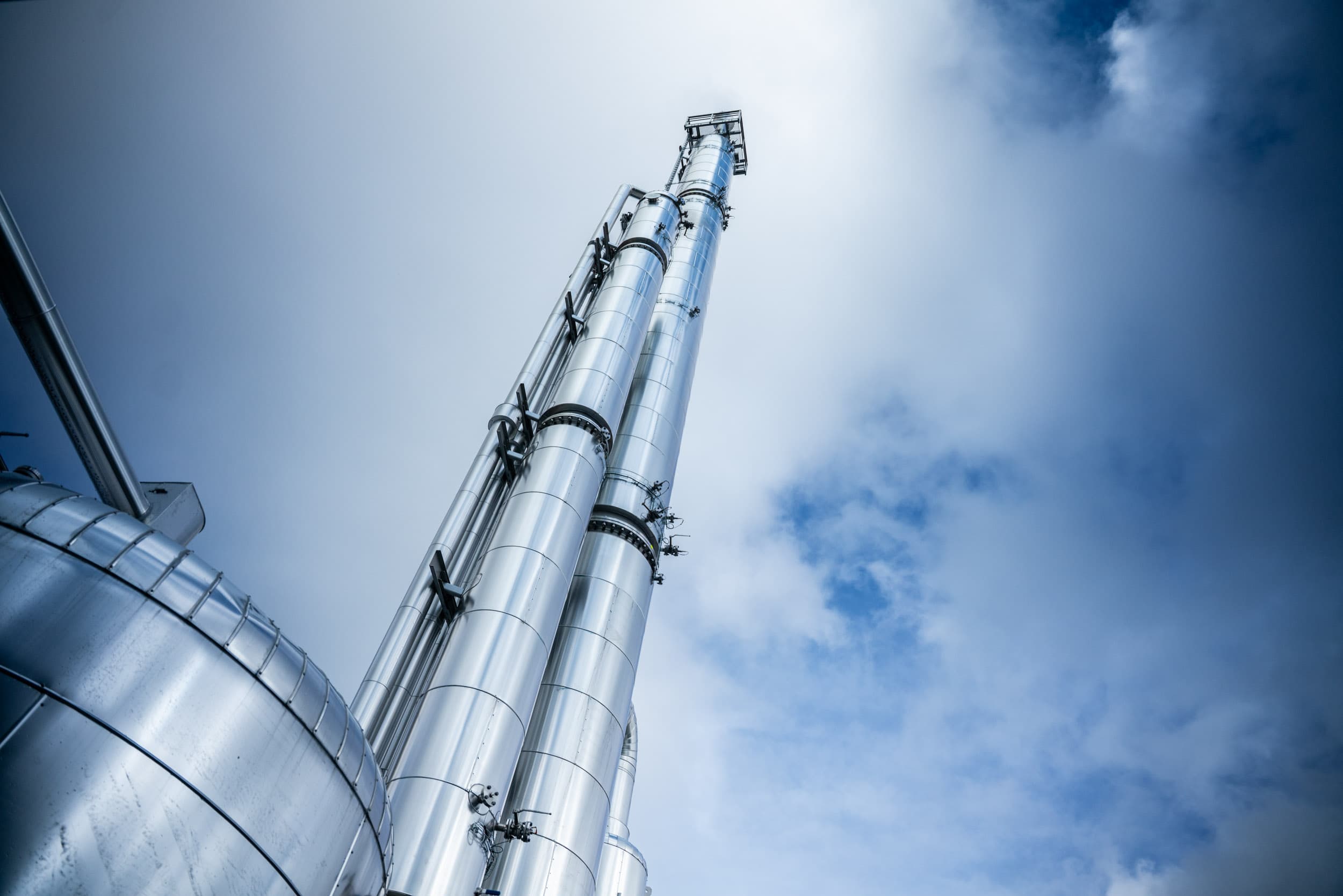
CO₂ from biomass combustion rises through the stack
Biomass combustion
Biomass, such as wood and organic waste, is combusted to produce energy. The combustion releases CO₂ in the flue gas. Since the biomass is biological, this is CO₂ that was recently in the atmosphere.
Flue gas enters from below, cleaned gas exits at the top
Absorption
The flue gas enters the absorption column, where it meets an amine-based solvent. The solvent chemically binds to the CO₂ molecules. The remaining flue gas is released.
The reboiler heats the solvent, CO₂ rises and exits at the top
Regeneration
The CO₂-rich solvent is pumped to the stripping column and heated. The heat breaks the chemical bond, releasing the CO₂ as a near-pure gas. The lean solvent is recycled back to the absorber.
Three compression stages raise pressure stepwise to over 100 bar
Compression
The pure CO₂ gas is compressed through multiple stages to supercritical state, which occurs already at around 74 bar, and further to above 100 bar to withstand the pressure drop across the whole pipeline transport. In this state, CO₂ behaves like a liquid and is ready for injection into geological formations.
CO₂ injected beneath the seabed, mineralising over time
Geological storage
The compressed CO₂ is permanently injected into porous rock formations deep beneath the seabed. Over time, the CO₂ mineralises and becomes rock. This is permanent, verifiable storage for thousands of years.
What happens to the CO₂ beneath the seabed?
Many have questions about the storage of CO₂, and whether it is safe. Here is the answer, based on what Northern Lights and Equinor themselves have documented.
Equinor has stored CO₂ from gas production at the Sleipner field in the Utsira formation beneath the North Sea since 1996, and at Snøhvit since 2008. The stores have been monitored with seismic surveys throughout. Northern Lights, the storage part of the state-backed Longship project, received its first CO₂ in August 2025.
The CO₂ is pumped down as a dense fluid into porous sandstone one to three kilometres beneath the seabed. At Northern Lights the depth is 2,600 metres. The sandstone is full of tiny pores currently filled with brine, and it is in these pores that the CO₂ settles.
Above the sandstone lies a thick layer of dense shale, a cap rock, that the CO₂ cannot pass through. It is exactly the same mechanism that has kept oil and gas trapped in the bedrock for millions of years. Before a store is used, the operator must document that the cap rock is sealed, including by drilling an appraisal well.
The storage becomes more secure with every year. The CO₂ is trapped in the pores by capillary forces, it dissolves into the brine and becomes heavier than the surrounding water so that it sinks rather than rises, and some of it reacts with minerals in the rock and turns into solid carbonate. In basalt, as in Iceland, that last process takes only a few years. In sandstone it takes longer, but there the cap rock does the job.
The operator continuously measures pressure and temperature in the wells and repeats seismic surveys to check that the CO₂ is moving as the models predict. Storage beneath the seabed requires a permit from the Norwegian authorities, and the operator remains responsible for the store for decades after injection ends.
Recognised carbon removal methodologies require documented storage for at least 1,000 years before a tonne can count as removed. A CDR certificate is issued only once the CO₂ has been injected and the storage confirmed, not when it leaves the capture plant.
The storage site for Kirkenær has not been finally chosen. Northern Lights is one of the options. Facts about Sleipner, Snøhvit and Northern Lights are taken from the operators' own publications, updated September 2026. Can it leak out? Read the answer →
Watch Raymond and Kenneth explain how carbon capture works at Carbon Centric
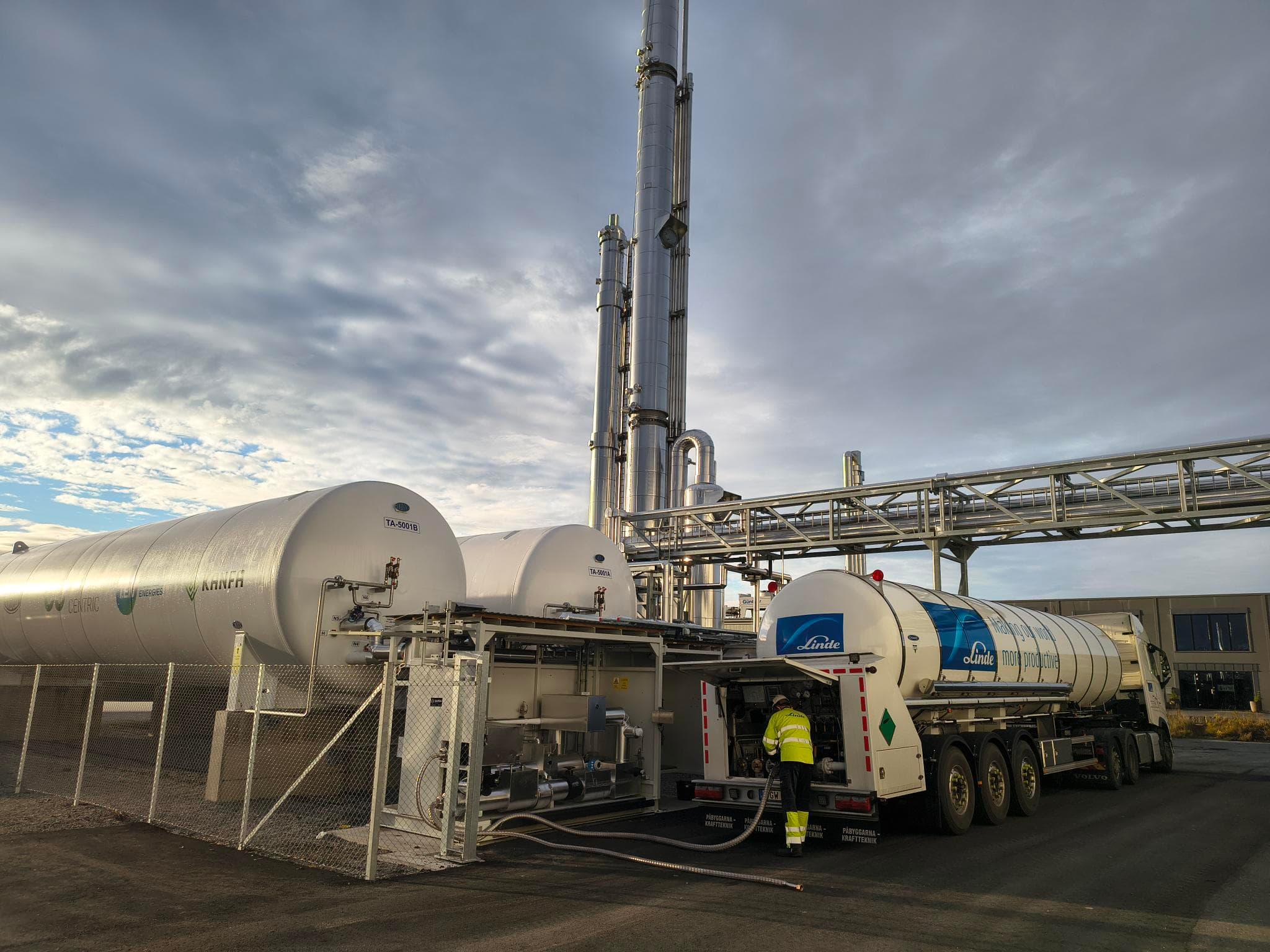
A walkthrough of the carbon capture process at the Rakkestad plant, which today supplies CO₂ for industrial use (CCU). Permanent storage is designed into our upcoming BECCS projects, starting with Kirkenær.
How does one tonne of CO₂ become one CDR certificate?
A CDR certificate is the proof that one tonne of CO₂ has been removed from the atmosphere and stored permanently. In the industry it is often called a carbon credit. This is how it comes about:
Over 450 sensors log the CO₂ capture in real time and report to our MRV platform. The documentation follows the CO₂ on to the store.
A third party, accredited under a recognised methodology, verifies every tonne and that it has actually been stored. No certificates are issued without approval.
After verification, a CDR certificate with a unique serial number is issued in a public registry. Buyers who have pre-purchased receive their certificate at that point.